Showing posts with label science. Show all posts

Friday, May 16, 2025

Must We Pretend?

An article at countercurrents.org said this recently:

«A new study has warned that if global temperatures rise more than 1.5°C, significant crop diversity could be lost in many regions»
Global Warming and Food Security: The Impact on Crop Diversity

Are we not sufficiently at the 1.5°C mark that this dance in reporting is ludicrous?

I'm starting to perceive the weather/climate distinction less as a matter of scientific certainty and more as an excuse to delay action for a long time. Here that distinction seems to be actively working against the cause of human survival by delaying what seems a truly obvious conclusion, and in doing so giving cover to inaction.

We already have a many year trend that shows things getting pretty steadily worse year over year, with not much backsliding, so it's not like we realistically have to wait 10 years to see if this surpassing 1.5°C is going to magically go away on its own. Indeed, by the time we get that much confirmation, these effects we fear will have seriously clubbed us over the head for too long.

«“The top ten hottest years on record have happened in the last ten years, including 2024,” António Guterres said in his New Year message, stressing that humanity has “no time to lose.”»
2024, Hottest Year on Record, Marks ‘Decade of Deadly Heat’

I keep seeing reports (several quoted by me here below) that we averaged above that in 2024, A haiku, in the ornate Papyrus font, that reads:

«sure, 1.5's bad
but we only just got there
wake me in ten years»

Below the haiku, in a smaller, more gray font, is added:

© 2025 Kent M Pitman so I find this predication on a pipe dream highly misleading.

Even just wordings suggesting that the crossing of some discrete boundary will trigger an effect, but that not crossing it will not, is misleading. It's not like 1.49°C will leave us with no loss of diversity, but 1.51°C will hit us with all these effects.

What needs to be said more plainly is this:

Significant crop diversity is being ever more lost in real time now, and this loss is a result of global average temperatures that are dangerous and getting moreso. That they are a specific value on an instantaneous or rolling average basis gives credibility and texture to this qualitative claim, but no comfort should be drawn from almost-ness nor from theoretical clains that action could yet pull us back from a precipice that there is not similarly substantiated qualitative reason to believe we are politically poised to make.

Science reporting does this kind of thing a lot. Someone will get funding to test whether humans need air to breathe but some accident of how the experiments are set up will find that only pregnant women under 30 were available for testing so the report will be a very specific about that and news reports will end up saying "new report proves pregnant women under 30 need air to breathe", which doesn't really tell the public the thing that the study really meant to report. Climate reporting is full of similarly overly specific claims that allow the public to dismiss the significance of what's really going on. People writing scientific reports need to be conscious of the fact that the reporting will be done in that way and that public inaction will be a direct result of such narrow reporting.

In the three reports that I quote below, the Berkeley report at least takes the time to say "recent warming trends and the lack of adequate mitigation measures make it clear that the 1.5 °C goal will not be met." We need more plain wordings like this, and even this needs to have been more prominently placed.

There is a conspiracy, intentional or not, between the writers of reports and the writers of articles. The article writer wants to quote the report, but the report wants to say something that has such technical accuracy that it will be misleading when quoted by someone writing articles. Some may say it's not an active conspiracy, just a negative synergy, but the effect is the same. Each party acts as if it is being conservative and careful, but the foreseeable combination of the two parts is anything but conservative or careful.

References
(bold added here for emphasis)

«The global annual average for 2024 in our dataset is estimated as 1.62 ± 0.06 °C (2.91 ± 0.11 °F) above the average during the period 1850 to 1900, which is traditionally used a reference for the pre-industrial period. […] A goal of keeping global warming to no more than 1.5 °C (2.7 °F) above pre-industrial has been an intense focus of international attention. This goal is defined based on multi-decadal averages, and so a single year above 1.5 °C (2.7 °F) does not directly constitute a failure. However, recent warming trends and the lack of adequate mitigation measures make it clear that the 1.5 °C goal will not be met. The long-term average of global temperature is likely to effectively cross the 1.5 °C (2.7 °F) threshold in the next 5-10 years. While the 1.5 °C goal will not be met, urgent action is still needed to limit man-made climate change.»
Global Temperature Report for 2024 (Berkeley Earth)

«The global average surface temperature was 1.55 °C (with a margin of uncertainty of ± 0.13 °C) above the 1850-1900 average, according to WMO’s consolidated analysis of the six datasets. This means that we have likely just experienced the first calendar year with a global mean temperature of more than 1.5°C above the 1850-1900 average.»
WMO confirms 2024 as warmest year on record at about 1.55°C above pre-industrial level

«NASA scientists further estimate Earth in 2024 was about 2.65 degrees Fahrenheit (1.47 degrees Celsius) warmer than the mid-19th century average (1850-1900). For more than half of 2024, average temperatures were more than 1.5 degrees Celsius above the baseline, and the annual average, with mathematical uncertainties, may have exceeded the level for the first time.»
Temperatures Rising: NASA Confirms 2024 Warmest Year on Record

Author's Notes:

If you got value from this post, please “Share” it.

This grew out of an essay I posted at Mastodon, and a haiku (senryu) that I later wrote as a way to distill out some key points.

Thursday, May 8, 2025

Linked World

[A simple image of the western hemisphere with continents in green and the ocean in blue.]

Inextricably Intertwined

Traditionally, business and politics have been separable in LinkedIn, but their overlap since November is far too substantive and immediate for that fiction to be further entertained.

[A white rectangle with blue lettering that spells 'Linked' and a globe after it, as if to say 'Linked world'. The globe shows the western hemisphere with continents in green and the oceans in blue. There is some similarity to a LinkedIn logo in general structure, though the relationship is intentionally approximate.]

And yet there are people on LinkedIn who still loudly complain that they come there to discuss business and are offended to see political discussion, as if it were mere distraction.

I don't know whether such remarks are born of obliviousness or privilege, but in my view these pleas lack grounding in practical reality. If there were a way to speak of business without reference to politics, I would do it out of mere simplicity. Why involve irrelevancies? But the two are just far too intertwined. US politics is no longer some minor detail, distinct from business. It is central to US business right now.

Some will see this shift as positive. Others will see it as negative. I'm one of those seeing consistent negatives. But whatever your leaning, it seems inescapable that politics is suddenly visibly intertwined with markets and products in new ways. Not every discussion must factor it in, but when it happens, it's not mere rudeness that has broken the traditional wall of separation. It's just no longer practical to maintain the polite fiction that there's no overlap.

Practical Examples

I find it impossible to see how a seismic shift like the US is undergoing could fail to affect funding sources and trends, individual business success, entire markets, and indeed whether the US is a good place for people to invest in, go to school in, or vacation in.

Nor are the sweeping effects of DOGE, Musk's Department of Government Efficiency, an issue of pure politics. Its actions have clear business impact. As Musk wields this mysterious and unaccountable force to slash through the heart of government agencies with reckless abandon, there are many clear effects that will profoundly affect business.

  • Scientists at the US Centers for Disease Control (CDC) and elsewhere have warned about the possibility of a bird flu or other pandemic. The CDC tracks and seeks ways to prevent pandemics, but that work is now under threat by an anti-science administration. As the Covid experience tells us, there is a business impact to pandemics if we allow them to just happen. A report in the National Institutes of Health (NIH)'s National Library of Medicine places that cost at about $16 trillion dollars.

  • The Federal Aviation Administration (FAA) is important to keeping planes in the air and having them not crash into one another. Business people do a lot of flying, so their needless deaths in the aftermath of FAA layoffs can presumably affect business. And it won't help people if the public develops a fear of flying.

  • The Food and Drug Administration (FDA) is in charge of making sure the food we eat does not poison us or that the drugs we take have at least a bounded degree of risk. It's the kind of thing you don't think might be business related until we enter a world where employees might go home any old day and just die because we are edging toward a society where you can't take food and drug safety for granted as a stable quantity any more.

  • The National Oceanic and Atmospheric Administration (NOAA) is responsible for tracking storms so that damage, injury, or death can be minimized. And then and the Federal Emergency Management Agency (FEMA) helps the recovery afterward. It is hard to see how a major storm could affect people, cities, or geographic regions without affecting the employees, customers, and products of businesses. Do I really have to say that? If people think there is a separation between business and politics, I guess I do.

    And then of course NOAA does work to study Climate Change, too. Not only has such study suggested that Climate Change is an existential threat to civilized society, perhaps to all humankind, but it turns out that if human society falls or humans go extinct, that will affect business, too. And maybe soon enough that people still alive now, even if they have no care about future humans, still need to care because it could affect them or those they love.

It used to be that business did not have to worry about such things as much exactly because government used to see it as its job to invisibly take care of these many things. But this change in politics is not just a change in spending, but a shift of responsibility from the government to businesses and individuals. They'll have to look out for themselves now. That is a big deal thing that will affect businesses—their products, employees, and customers in profound ways. All the more so because the present administration changes its mind daily in ways that seem to have no plan, so uncertainty abounds. Business hates uncertainty.

Unemployment

Additionally, the many layoffs in government mean additional unemployment, which itself has business effect. Perhaps some will rejoice at a plentiful supply of potential workers or the fact that they may accept lower wages. But, meanwhile, those unemployed were also the customer base of other businesses who will be less happy. Those people aren't in a position to buy as many things—not just luxuries but essentials like food and rent and healthcare. Perhaps others in their families will pitch in to help them survive, but then those people won't be in a position to buy as many things either.

Mass layoffs do not happen in a vacuum. Those political choices will show up on the bottom lines of businesses. Some businesses may not survive that loss of business, creating a cascade effect.

Racism and Xenophobia

Racism and xenophobia are on the rise. Recent ICE actions seem designed to send the message that we purposefully treat some humans like vermin. “Stay away,” it screams to a large swath of the global population, some of whom we might like to sell to or have invest in us.

It began by going after the undocumented, surely because they are easy targets. That circle is expanding, and it seems unlikely to stop any time soon. The goal seems to be to end any sense that anyone has rights at all. That creates a lot of uncertainty about what is allowed in the way of both speech and action. Such uncertainty makes it hard to plan and manage anything from the selection of an appropriate employee base to how products will be positioned and marketed.

Also, it's an ugly truth that the US relies on already-terrified undocumented employees to accept very low wages, sometimes perhaps skirting wage regulation. Many US businesses will lose access to such cheap labor. The ethics of having relied on this population in this way are certainly tangled and I don't want to defend this practice. But for purposes of this discussion I simply observe that this change will have business effects that may affect both prices and product availability.

It is as if the administration's answer to immigration concerns is to make the US seem as utterly hostile to anyone who is not a native-born, white, Christian male. These trends already affect who feels safe coming to the US to trade, to study, to do research, and to found companies. It's going to be hard to unring that bell.

Rule of Law

In addition, this process seems to be having the side-effect of diminishing rule of law generally. By asserting that due process is not required, when plainly it is, a test of wills is set up between the executive and the rest of the government as to whether the President can, by mere force of will, ignore the Constitution entirely.

The clear intent is to establish us as a bully power, to say that worrying about whether foreigners like the people of the US showed weakness, and that we must make the world fear us. That shift cannot help but affect who will do business with us and how.

We cannot expect our global peers, already horrified by the recent shift in our choice of which foreign entities to fund or ally ourselves with, to shrug these matters off in business with a casual "oh, that's just politics."

Education

Also, higher education is under assault. There is a complex ecology here because people from around the world have revered our universities as places they could send people to acquire a world class education. But with research funds being cut, that may no longer be so.

That the US Government seems intent on snatching foreign students off the street does not make this picture any better. It becomes a reason for international investment dollars to go to other countries where it is safe to walk the streets.

International Investment

The education system is not cleanly separated from the business community. There is a complex ecology in which many businesses locate themselves near universities to have access to the best human talent and research the world has to offer. As US educational institutions are undercut, and the administrations anti-science agenda is pursued, foreign businesses that take education and science more seriously may look elsewhere for leadership.

These capricious changes—the sense that nothing is promised or certain—may affect the reputation of the United States and trust in the US dollar. The present administration wants more control of the Federal Reserve, which has traditionally operated independently. If that happens, it could worsen faith in the US dollar.

The US has also weakened enforcement of anti-bribery laws for dealing with foreign governments. Perhaps some will regard this relaxation of ethics good for business, but whether you do or not, it is most certainly a major change.

And the US is demonstrating on-its-face incompetence at every level of government because everyone with a brain is deferring to someone who plainly lacks either understanding or caring about the damage he is doing. Foreign businesses and governments used to look to the US as a place that had something to teach, but as this incompetence continues unchecked, it cannot help but hurt our reputation internationally.

Philosophy of Government

There is a definite push to “run government like a business.” I think that's a terrible plan, as my recent essay Government is not a Business explains.

But whether you think running government that way is good or bad, it marks a profound shift. More privatization and, with that, probably more corruption. These are things that will profoundly affect not just the US political landscape, but also its business landscape.

Not Separable

Hopefully these examples make it clear that politics and business are no longer separable. It is simply impossible to discuss business in a way that neglects politics. All business in the US is now conducted in the shadow of a certain GOP Elephant that manages to insinuate itself into every room.


Author's Notes:

If you got value from this post, please “Share” it.

Some parts of this post originated as a comment by me on LinkedIn. Other parts were written separately with the intent of being yet another comment, but I finally went back and unified the two and pulled this out to a separate post where I was not space-limited.

The vague approximation to the LinkedIn logo was created by me from scratch in Gimp by looking at the LinkedIn logo and doing something suggestive of the same look. A globe image was obtained from publicdomainpictures.net under cc0 license, and post-processed by me in Gimp to work in this space. I just made guesses about sizes, proportions, fonts, and colors. At no time were any of actual logos used for any part of the creation.

Saturday, March 28, 2020

Humanity's Superpower

[Image of simplified scheme of Millikan's experiment.]

Science is a superpower.

Science is an ability to see things our eyes do not yet show us, things that if we wait to see them, we'll find it's too late to react to.

Science is a superpower.

Science lets us see long distances. It lets us see inside things. It lets us see, prepare for, and avoid coming disasters. It gives us an edge in the quest for survival.

Science is a superpower.

Science is why we can predict hurricanes and not just be surprised and blown to bits by them in the moment they happen.

Science is why were able to land humans on the moon and return them safely to Earth on the first try. We had seen past our optimism to the many ways we could fail, and planned to avoid them.

Science is the superpower that told us decades ago that the climate would be changing, that we needed to prepare. It lets us see that the polar bear plight isn't just sad for a bunch of majestic but distant animals, but a way to metaphorically visualize a world made unlivable by changing climate if we continue to ignore that amazing power, learning the lesson too late.

Science is the superpower that allowed Li Wenliang to see and understand the threat of Covide-19 long before the virus had spread.

Science is a superpower.

Science is a superpower that stands as a rock against rationalization and politics, that acts as a beacon to guide us through swirling fogs of wishful thinking and denialism.

Science helps us to recognize and manage a great many dangers without resorting to stupid human tricks. It gives us the tools to bust myths safely.

Science is a superpower.

Without Science, our first encounter with a dangerous force is likely to be our last. Science offers super-vision, the ability to see beyond what is merely available to our eyes. But only if we opt to use that power.

If we super-stupidly elect to close our eyes to Science, rendering ourselves super-blind, we're just asking to find ourselves super-dead.


Author's Notes:

If you got value from this post, please “Share” it.

The public domain image used here was obtained from Wikimedia and was donated to them by Wikimedia user Mpfiz, whose contribution is gratefully acknowledged.

Saturday, September 21, 2019

Degrees of Climate Catastrophe

What's the most civilization-destroying error in climate communication? I guess this is something that people might disagree on, but to me it has a very definitive answer: It's talking about climate change severity in terms of degrees Celsius (°C).

Scale

To begin with, it seems like using Celsius rather than Fahrenheit has to make it easier for folks here in the US to lowball or ignore those numbers. We're used to bigger numbers. For example, 3°C sounds small, since we're used to hearing it referred to as 5.4°F. The use of small numbers surely causes some people in the US to dismiss worries over temperature change even faster than they already seem predisposed to do.

Thinking Linearly

Another problem is that use of degrees is a linear measure, but °C as a measurement of badness is confusing because the badness doesn't grow linearly. In other words, if a rise of 1°C has some amount of badness B, it is not the case that a rise of 2°C is twice as bad, and 3°C is three times as bad. The rate that things get bad is worse than that. Some sort of upwards curve is in play, perhaps even exponential growth like Michael Mann's hockey stick. If small integers are proxying for exponential degrees of devastation to society, that's another reason °C is a bad measure. Well-chosen terminology will automatically imply appropriate urgency.

Quantitative vs. Qualitative

And, finally, measuring Climate Change severity in degrees seems to me an open invitation for people to confuse weather with global average temperature. I'm just sure it must affect their sense of urgency. After all, daily weather varies hugely with no global consequence. Small numbers of degrees sound like something that should influence whether you pick out a sweater to wear for the day, not whether human civilization is at risk of coming to an end.

If instead of using small-sounding, homogeneous, quantitative labels like 1°C, 2°C, etc. we used more descriptive, heterogeneous, qualitative labels like

  • home-destroying
  • community-destroying
  • nation-destroying
  • civilization-destroying
  • ecosystem-destroying

we might better understand conversations warning of climate danger. I'm not wedded to these particular words, but they illustrate what I mean by “qualitative” rather than “quantitative” measures. I'd just like the scientists to move away from dinky little numbers that sound like harmless fluctuations on a window thermometer.

To me, small numbers are too abstract and clinical. I think we need words like this that evoke a more visceral sense of what the world looks like if temperature is allowed to rise. Rather than talk about “5°C rise,” I would rather people talk about “climate that threatens civilization itself,” because then we'll have an ever present and highly visible understanding of the stakes.


If you got value from this post, please “share” it.

By the way, an early version of this idea was something I tweeted about in May, 2019.

Tuesday, May 14, 2019

Democratizing Climate Discussion

The Importance of Keeping Pace

In the early days of the web, it was not obvious that sites like AltaVista (the original full text search site, predating Google and others) would win the “web search” wars. It seemed to me that keyword-driven, manually curated sites—like Yahoo started out to be, if I recall correctly—did a more recognizable thing, classifying and filing everything in the world into neat little categories where you could go and look things up more like the paper encyclopedias I grew up with.

Full text search, by contrast, seemed messy and really like such a terrible solution. How could anyone possibly rely on the actual text of something in a durable way? And yet, what we found was that it was just too expensive to add keyword metadata to content at the pace it was arriving on the web. Orderly, manual curation of knowledge couldn't keep up. The web was destined to be messy, and the tools that would survive had to embrace that messiness.

Passing the Baton

There's an important lesson here for those involved in the science and politics of Climate Change, I think.

Bill Nye's recent video about a world on fire, using colorful language to wake people up, has ignited a burst of public conversation about Climate.

But in addition to the simple shock of seeing Nye use foul language, there's another and more important issue in play here: Fixing climate is a relay race. There is much to be done and scientists are not sufficient in number or skill to get us across the finish line. The baton needs to pass from the scientists to regular people.

Until now, we have been relying for a long time on scientists to lead the climate conversation. Science is and will continue to be an important aspect of the conversation, but it must move beyond that. Regular people, people without credentials, need to feel free to speak. We all need to own this discussion, to personalize it, to take responsibility for it. We can't expect it to be done by others.

Unchaperoned Climate Debate

The language of science is careful, precise peer-reviewed, cautious. The language of regular people is not. Until this point, we've allowed “others” to talk about climate, but often only with a scientist looking over their shoulder like nervous parents watching a child learn to use a sharp knife. The slightest misstatement might be quickly corrected, but it's a too-slow process to roll out at scale.

And, in fairness, there has been a lot of misinformation out there, so the corrections have been helpful in many ways. There are people who are strongly motivated by short-term profits to introduce misstatements and to see them replicated as memes. So one can easily understand the desire of scientists to watch over the conversation and insist it adhere to standards. They say it's not paranoia when the enemy is real.

But people are finally starting to get it, and as they do, the discussions move faster—much faster than scientists can keep up with. So tactics and norms have to shift to respond. We need people talking all the time everywhere. Addressing climate change is a big problem, and it needs to be at the core of pretty much everything society does. And we don't have enough scientists to chaperone all those conversations.

The language of regular people is coarse, poetic, abbreviated, blurry, emotional, imprecise, and most important unchecked. I often find myself telling people that the Climate problem is about physics, and that physics doesn't negotiate. Here is where I have to push back on the scientists: the Climate discussion problem is about human socialization, about how we build consensus, about how we express our goals and fears, about how we manage trust. These are things that scientists can't negotiate away. In order for public dialog to proceed, scientists need to prepare themselves for sloppy conversations, conversations that frankly will not make them happy at the detail level.

Climate scientists will need to loosen their grip.

A Coping Mechanism for Nervous Climate Parents

A thing that bothers me about Climate messaging—makes me terrified actually—is that climate badness is expressed in degrees of global average temperature. This leads to big confusion because within the course of a single day, weather and local temperature varies a lot. Temperatures at any given location might fluctuate ten or twenty degrees in a day and we wouldn't think that anomalous. Sometimes that's just the difference between day and night, sometimes the effect of a storm or a new front moving in. But if the global average temperature went up by ten or twenty degrees, we'd be cooked. We expect regular folks to get that, but I'm not sure they always do.

Temperature is not distributed evenly, so even though the temperature might be spiked high in one place, it might be quite low in another (or vice versa). It only matters that it averages out. Scientists shrug off local anomalies because they understand that the global average is quite different than any one point location. Let me suggest that there is an important metaphorical lesson for scientists there about how to manage conversation.

Just as daily temperature fluctuations outside your house don't tell you much about climate, so too the daily misstatements by individuals also don't matter either, as long as the overall message trends are right. Some will get the data right, some wrong. Some will exaggerate to make things seem worse, some to make it seem better. People will understand and communicate the problem in different ways, but we have to let them do that. That's part of integrating the message into society. It can't be done some other way.

If the public at large, on average, is panicking that we're going to die tomorrow, or in the other direction if the public is lulled into thinking there's not a problem, it's definitely worth scientists stepping in to speak to that general trend in an organized way. But if a given scientist on a given day observes someone who they feel hasn't got the message quite right, they need to be prepared to hold back. Regular people need to feel they have the right to speak freely without being slapped down for it. Also, an exaggeration in some places may add balance to another person being too unconcerned.

Think about the ways we talk about health or war or other big issues. The conversation is not at every point precise, but it isn't always the wrong way to gain consensus.

At this point, I think, it's better to just let people run with it for a while and see what the trend is than to get involved in the microscopic detail of every single conversation, hoping against hope that scientists can, by force of will, make everyone be precise. That isn't the path to the solution.

Climate scientists need to let go, so they can get their sleep and focus on their research and be ready to answer questions. I don't think they have to worry we'll suddenly have no need of them. Their role just needs to change. They are still are trusted advisors, but they cannot be our nannies. We need both permission and pressure to grow up, to take this on ourselves.

Author's Notes:

If you got value from this post, please “Share” it.

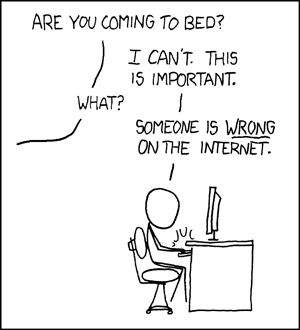
xkcd comic “duty calls” by Randall Munroe used with gratitude under Creative Commons Attribution-NonCommercial 2.5 Generic (CC BY-NC 2.5) license.

Saturday, May 16, 2009

George

When I was around the age of five, my parents gave me a little stuffed bear, A well-loved brown teddy bear with a surface that is unevenly textured and bare in some places due to wear. Stiched seams are visible on  his torso, some of which have been crudely repaired by coarser hand stiching. A small wind-up key with a hinged, penny-like handle adorns his chest—like a pendant. He sits upright on a wooden table, his arms outreached, as if in perpetual need of, or offer of, a hug. who I named George.

He was no ordinary bear, of course. He had eyes that seemed very deep and knowing, and for a while he had a felt red mouth, though that fell away at some point.

Inside, he had a music box. There was a metallic key extending from his chest—the kind that's probably unsafe and illegal in the modern world where doubtless they must be made of fireproof, non-toxic, biodegradable, nerf-like sponge foam. But this old-fashioned key just jutted out harshly with a piece of metal like a penny that attached to the pole allowing you something flat to hold while you twisted it to wind him up. Thus armed, he would play a bit of the song Around the World in Eighty Days, which I came to like quite a lot.

One day the music box broke, though. I must have been in first or second grade and wasn't sure what to do. Twisting it didn't manage to catch something it needed to catch, and when you let go after twisting it would just play all the notes really fast in a kind of single quick metallic zing sound that took only a second or two to complete. It was quite disappointing.

So I did what kids do. I threw George against the wall. To my surprise, that fixed him, and the music box played again. I was thrilled.

Sometime not too long after, though, he broke again. But fortunately, I was now a skilled bear repairman. Or so I thought. Sadly, no matter how many times I threw George against the wall, and I tried it quite a lot before giving up, it just didn't seem to help and mostly seemed to be scratching up the wall with that bit of metal that stuck out.

Later in life, I'd had more school and learned that there were “best practices” for fixing broken things, and that bashing them against the wall mindlessly was not among them.

And yet, sometimes I look at the way certain people approach the world and think it sad that they never had a George to teach them this lesson. Failing to understand science and causality, they resort to mysticism and a belief that if something once worked, even by accident, it will somehow find a way to work again, even without knowing why it ever worked or whether that reason is still in play.

Periodically I hear people referring to Climate Change as a natural process, as if that implies it will fix itself. They say the climate has corrected itself before, and so they seem comfortable that it will happen again. They don't say how or why or even when this will happen, so I must infer they are expecting it to happen by magic—and just in time to avoid any inconvenience to mankind.

Maybe it's just my personal experience that leads me to say this, but ... I'm just not so sure we can rely on either repeated good luck or outright magic.

It's time for some serious science.

Footnote

I still have George. He's threadbare here and there, but still loved. My parents tried to get me to throw him away when they thought me too old for him, but I refused. I'm glad I still have him. His music box still doesn't work on its own, but if you help him by holding the key just right and refusing to let the key unwind faster than it should, you can still get him to play his tinny tune. It still makes me smile.


Author's Note: If you got value from this post, please “Share” it.

Originally published May 16, 2009 at Open Salon, where I wrote under my own name, Kent Pitman.

Tags (from Open Salon): politics, climate change, global warming, science, mysticism, engineering, best practices, mindlessly, koan, lesson, childhood memories, lessons learned, bear, teddy bear, george, teddy bear named george, hypothesis, test, growth, experience, trust