After laws broken daily for years,
“Shocked, Shocked” are a Speaker and peers.
Now they’ll risk reelection,
raising one thin objection.
“Too little, too late” are my fears.
Limerick is not my preferred format. I usually prefer haiku, or (as here) senryu. There's something calmer and more
elegant about it. So I also tweeted a senryu, perhaps as apology for the limerick above:
Crimes mount by the day.
Biden chides, “soon, it's too much.”
What was it before?
Author's Note:
If you got value from this post, please “Share” it.
“a ‘ground’ is usually idealized as an infinite source or sink for charge, which can absorb an unlimited amount of current without changing its potential”
—Wikipedia Ground (electricity)
There is a notion in electronic circuits of something called a “ground.” It takes its names from the ground we walk on,
and the idea is basically that the ground, really the Earth itself, is so incredibly big that it contains an infinite number
of electrons, the “stuff” of electricity. So if we ever need a source to draw electrons from, we can get them from the ground.
If we ever need to get rid of some electrons, we can just pump them back into the ground.
It's for this reason that we have a “ground” pin in our electrical outlets,
in hopes that rogue flows of electricity will make a beeline for the ground rather than flowing through our bodies.
Plenty of room for more electrons in the ground.
What We Hold to Account
Another way of thinking about “ground” is to say it's something we don't have to account for.
Consider, for example, a tool for keeping track of your finances.
Such programs keep track of several kinds of entities, but among them are typically things usually called something like an “income source” and an “expense category.”
An income source is as a place from which income arrives.
When you say your employer is the source of your income, that's really all you need to know. It's not really consequential where
the employer got the money. If you had to track such things, there would be no end to it. They might have gotten it from someone else.
But where did they get it? It goes on and on.
Expenses are the same way. You pick an expense category like food and you tell the program you spent $20 on food.
It doesn't really care what the food place did with the money. As far as it's concerned, you can spend as much as you want and that's
the end of it. All gone into who-knows-where.
The point of an income source in an accounting program is to be an infinite source of money, a ground.
The point of an expense category is to be an infinite sink of money, something to pour money down, again a ground.
We think of these as ways of accounting for stuff, but really they are ways of not accounting for things.
Out of sight, out of mind. That's what grounds are for. They are a way of notating the idea that beyond this point, we just don't care.
“Europe was hitting up against nature's limits.
They'd overfished their rivers, felled their great forests,
and hunted their big game.
When European conquerors stumbled upon the so-called New World,
they thought they'd hit the jackpot.
They saw in the Americas a kind of supersized Europe
that would never run out of fish, trees, gold, fur, or any of that bounty.
…
The official story of our countries is a story of endless nature,
wilderness to be devoured without limits.”
Naomi Klein's excellent and insightful video “What's In a (Trump) Straw?”
makes the important observation that people have been used to thinking about the world as infinite, when really it is not.
In this case, it's not electrons we're talking about, however.
In her conceptualization, there is a kind of rough analog of income sources—the bounties we draw from the earth:
fish and game, trees, and so on.
And there is also an analog of expense categories—the various kinds of pollution we give Mother Earth in return:
sewage, plastics, and air pollution of various kinds.
Stuff we never previously had to account for, because we had a belief that the world was so infinitely large that it would
supply us with as much as we needed of whatever we wanted. And we deceived ourselves into believing it would gracefully accept in return
as much crap, both literally and figuratively, as we wanted to throw back at it in return.
Shocking, But True
The Earth is still big enough that we haven't used up its capacity to act as an electrical ground.
But it is not big enough that we can pretend there are infinite trees to cut down, infinite fish to catch, or
that there is infinite capacity to spill oil into the oceans or pump smoke from fossil fuels into the air.
As population has grown, we've reached our limits. We should have been paying better attention.
But at this point, the pleasant fiction offered by the “ground” metaphor, that there's some point in the world beyond which
we don't have to account for these things, that things can be thought to go into or come from the ground as if by magic,
is long past.
Nature is holding us to account.
We must start caring about population growth and resource use. We should have been doing that all along.
It's going to be a big change. It's not something we're used to doing.
But there is no alternative.
We keep making more people, but we aren't making more planet and we're using up the one we have. That's a bad recipe.
If we're going to survive, we need to get these things into balance.
If you got value from this post, please “share” it.
What's the most civilization-destroying error in climate communication? I guess this is something that people might disagree on, but to me it has a very definitive answer: It's talking about climate change severity in terms of degrees Celsius (°C).
Scale
To begin with, it seems like using Celsius rather than Fahrenheit has to make it easier for folks here in the US to
lowball or ignore those numbers.
We're used to bigger numbers. For example, 3°C sounds small, since we're used to hearing it referred to as 5.4°F. The use of small numbers surely causes some people in the US to dismiss worries over temperature change even faster than they already seem predisposed to do.
Thinking Linearly
Another problem is that use of degrees is a linear measure, but °C as a measurement of badness is confusing
because the badness doesn't grow linearly. In other words, if a rise of 1°C has some amount of badness B,
it is not the case that a rise of 2°C is twice as bad, and 3°C is three times as bad.
The rate that things get bad is worse than that. Some sort of upwards curve is in play, perhaps even exponential
growth like Michael Mann's hockey stick. If small integers are proxying for exponential degrees of devastation to society,
that's another reason °C is a bad measure. Well-chosen terminology will automatically imply appropriate urgency.
Quantitative vs. Qualitative
And, finally, measuring Climate Change severity in degrees seems to me an open invitation for people to confuse weather with global average temperature. I'm just sure it must affect their sense of urgency. After all, daily weather varies hugely with no global consequence. Small numbers of degrees sound like something that should influence whether you pick out a sweater to wear for the day, not whether human civilization is at risk of coming to an end.
If instead of using small-sounding, homogeneous, quantitative labels like 1°C, 2°C, etc. we used more descriptive, heterogeneous, qualitative labels like
home-destroying
community-destroying
nation-destroying
civilization-destroying
ecosystem-destroying
we might better understand conversations warning of climate danger.
I'm not wedded to these particular words, but they illustrate what I mean by “qualitative” rather than “quantitative” measures. I'd just like the scientists to move away from dinky little numbers that sound like
harmless fluctuations on a window thermometer.
To me, small numbers are too abstract and clinical. I think we need words like this that evoke
a more visceral sense of what the world looks like if temperature is allowed to rise.
Rather than talk about “5°C rise,” I would rather people talk about “climate that threatens civilization itself,” because then we'll have an ever present and highly visible understanding of the stakes.
If you got value from this post, please “share” it.
In the early days of the web, it was not obvious that sites like AltaVista (the original full text search site, predating Google and others) would win the “web search” wars.
It seemed to me that keyword-driven, manually curated sites—like Yahoo started out to be, if I recall correctly—did
a more recognizable thing,
classifying and filing everything in the world into neat little categories where you could go and look things up more
like the paper encyclopedias I grew up with.
Full text search, by contrast, seemed messy and really like such a terrible solution.
How could anyone possibly rely on the actual text of something in a durable way?
And yet, what we found was that it was just too expensive
to add keyword metadata to content at the pace it was arriving on the web.
Orderly, manual curation of knowledge couldn't keep up. The web was destined to be messy, and the tools that would survive
had to embrace that messiness.
Passing the Baton
There's an important lesson here for those involved in the science and politics of Climate Change, I think.
Bill Nye's recent video about a world on fire, using colorful language to wake people up,
has ignited a burst of public conversation about Climate.
But in addition to the simple shock of seeing Nye use
foul language, there's another and more important issue in play here: Fixing climate is a relay race. There is much to be done
and scientists are not sufficient in number or skill to get us across the finish line. The baton
needs to pass from the scientists to regular people.
Until now, we have been relying for a long time on scientists to lead the climate conversation.
Science is and will continue to be an important aspect of the conversation, but it must move beyond that.
Regular people, people without credentials, need to feel free to speak.
We all need to own this discussion, to personalize it, to take responsibility for it.
We can't expect it to be done by others.
Unchaperoned Climate Debate
The language of science is careful, precise peer-reviewed, cautious.
The language of regular people is not.
Until this point, we've allowed “others” to talk about climate, but often only with a scientist looking over their
shoulder like nervous parents watching a child learn to use a sharp knife. The slightest misstatement might be quickly corrected,
but it's a too-slow process to roll out at scale.
And, in fairness, there has been a lot of misinformation out there, so the corrections have been helpful in many ways.
There are people who are strongly motivated by short-term profits to introduce misstatements and to see them replicated as memes.
So one can easily understand the desire of scientists to watch over the conversation and insist it adhere to standards.
They say it's not paranoia when the enemy is real.
But people are finally starting to get it, and as they do, the discussions move faster—much faster than
scientists can keep up with. So tactics and norms have to shift to respond. We need people talking all the time everywhere.
Addressing climate change is a big problem, and it needs to be at the core of pretty much everything society does.
And we don't have enough scientists to chaperone all those conversations.
The language of regular people is coarse, poetic, abbreviated, blurry, emotional, imprecise, and most important unchecked.
I often find myself telling people that the Climate problem is about physics, and that physics doesn't negotiate.
Here is where I have to push back on the scientists: the Climate discussion problem is about human socialization,
about how we build consensus, about how we express our goals and fears, about how we manage trust. These are things that
scientists can't negotiate away.
In order for public dialog to proceed, scientists need to prepare themselves for sloppy conversations, conversations that
frankly will not make them happy at the detail level.
Climate scientists will need to loosen their grip.
A Coping Mechanism for Nervous Climate Parents
A thing that bothers me about Climate messaging—makes me terrified actually—is that climate badness is expressed
in degrees of global average temperature. This leads to big confusion because within the course
of a single day, weather and local temperature varies a lot. Temperatures at any given location might fluctuate ten or twenty degrees in a day and we wouldn't think that anomalous. Sometimes that's just the difference between day and night, sometimes the effect of a storm or a new front moving in. But if the global average temperature went up by ten or twenty degrees, we'd be cooked. We expect regular folks to get that, but I'm not sure they always do.
Temperature is not distributed evenly, so even though the temperature might be spiked high in one place, it might be quite low in another (or vice versa). It only matters that it averages out. Scientists shrug off local anomalies because they understand
that the global average
is quite different than any one point location. Let
me suggest that there is an important metaphorical lesson for scientists there about how to manage conversation.
Just as daily temperature fluctuations outside your house don't tell you much about climate, so too the daily misstatements by individuals also don't matter either, as long as the overall message trends are right.
Some will get the data right, some wrong. Some will exaggerate to make things seem worse, some to make it seem better.
People will understand and communicate the problem in different ways, but we have to let them do that.
That's part of integrating the message into society. It can't be done some other way.
If the public at large, on average, is panicking that we're going to
die tomorrow, or in the other direction if the public is lulled into thinking there's not a problem, it's definitely worth scientists stepping in to speak to that general trend in an organized way.
But if a given scientist on a given day observes someone who they feel hasn't got the message quite right,
they need to be prepared to hold back.
Regular people need to feel they have the right to speak freely without being slapped down for it.
Also, an exaggeration in some places may add balance to another person being too unconcerned.
Think about the ways we talk about health or war or other big issues. The conversation is not at every point precise, but
it isn't always the wrong way to gain consensus.
At this point, I think, it's better to just let people run with it for a while and see what the trend is than to
get involved in the microscopic detail of every single conversation, hoping against hope that scientists can,
by force of will, make everyone be precise. That isn't the path to the solution.
Climate scientists need to let go, so they can get their sleep and focus on their research and be ready to answer questions.
I don't think they have to worry we'll suddenly have no need of them.
Their role just needs to change. They are still are trusted advisors, but they cannot be our nannies.
We need both permission and pressure to grow up, to take this on ourselves.
Author's Notes:
If you got value from this post, please “Share” it.
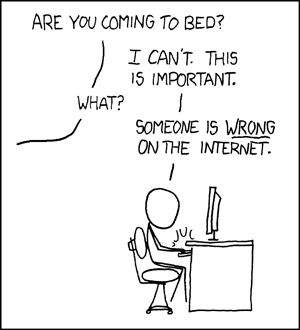
xkcd comic “duty calls” by Randall Munroe used with gratitude under Creative Commons Attribution-NonCommercial 2.5 Generic (CC BY-NC 2.5) license.
I have been frustrated over the failure of some Democrats to understand the urgency of the 12-year window. Some Democrats get it, others do not.
But whether they get it or not, this is the issue that mankind faces, an issue
that will determine all future history in dramatic ways.
This is not a time for compromise. The physics will not allow it. Better to fail trying than to give up the entire game by thinking it unwinnable,
as Nancy Pelosi seems bent on doing. Shame on her. That is not leadership.
Lately I look to Elizabeth Warren for leadership among the Democrats. She understands that sometimes you can't pick the timing or worry about appearances
but must do what needs doing.
And addressing Climate needs doing.
Climate Change is a cancer.
It must be treated early and properly. If we wait too long, no treatment will be possible.
There is nothing radical about an aggressive response to an existential threat to humanity.
There is nothing moderate about a take-your-time or middle ground approach to the Climate Crisis.
H.R. 9. Climate Action Now Act
This bill requires the President to develop and update annually a plan for the United States to meet its nationally determined contribution under the Paris Agreement on climate change.
H.R. 763. Energy Innovation and Carbon Dividend Act of 2019
This bill imposes a fee on the carbon content of fuels, including crude oil, natural gas, coal, or any other product derived from those fuels that will be used so as to emit greenhouse gases into the atmosphere.
H.R. 3761. Off Fossil Fuels for a Better Future Act (OFF)
This bill transitions away from fossil fuel sources of energy to clean energy sources (e.g., energy efficiency, energy conservation, and renewable energy).
S.Res. 59. A resolution recognizing the duty of the Federal Government to create a Green New Deal.
This resolution calls for the creation of a Green New Deal.
Beto For America. Taking On Our Greatest Threat: Climate Change
A four-part framework to mobilize a historic $5 trillion over ten years, require net-zero emissions by 2050, and address the greatest threat we face.
Inslee for America. America's Climate Mission
Building a Just, Innovative and Inclusive Clean Energy Economy. Subsequent to publishing this article, Inslee announced a lot more specifics.
To read his position paper on the “Evergreen Economy,” which he refers to as a refinement in detail to the abstract concept of a “Green New Deal,” click here.
I have my own preferences and concerns, but we can't let the perfect be enemy of the good.
We need to discuss all of them, respectfully. We need to collaborate among them, understand that each has good points that might be combined or borrowed from.
We need to move ahead on as many of these as we can or we will not make the 2030 deadline
set for us by physics.
I said it already, but it bears repeating: The physics part is not something we can compromise on. It's what we're given.
Physics doesn't grade on the curve. It doesn't care about the complexities of politics. It doesn't award trophies for trying or meaning well.
We will either take necessary action in the time allotted, or condemn our descendants to live forever with the unhappy consequences, assuming the
happy case that human extinction is not one of those consequences. I recommend David Wallace-Wells' book The Uninhabitable Earth if you need a visualization of what such a future world might look like.
I'll close here with one more appeal to metaphor, from a recent tweet of mine:
Climate is a train out of control, accelerating. Delay lets it accelerate more. Biden wants to schedule serious braking for another day. Physics says no, that if we delay, the brakes won't later be strong enough to use at all.
Scientists last year identified a “12-year window” (time marches, and the window is less now) during which we must decarbonize by 50% (reducing fossil fuel use, etc) if we are to still be able to affect Climate in this way at all. The problem is accelerating, though, and if we wait, we will lose this option and wish we had it back. It seems hard and expensive and disruptive now, but what will follow will be much, much worse.
In his book, The Uninhabitable Earth,
author David Wallace-Wells describes the problem this way: “If we had started global decarbonization in 2000, when Al Gore narrowly lost election to the American presidency, we would have had to cut emissions by only about 3 percent per year to stay safely under two degrees of warming. If we start today, when global emissions are still growing, the necessary rate is 10 percent. If we delay another decade, it will require us to cut emissions by 30 percent each year.”
No one should be fooled into thinking the actions proposed in the Green New Deal, including Beto’s recent variant, are “radical.”
They are anything but. If anything, they may be insufficient. But they are a credible start.
No one should be fooled into thinking more “moderate” approaches offered by so-called “centrist Democrats” are, in fact, moderate. They are moderate like the idea of treating an aggressive cancer in a lazy way is moderate. Moderation in treating Climate is delay. And delay is catastrophe, or worse, just as certainly as not treating at all.
Some have proposed market solutions, like a carbon tax (such as H.R. 763). Nothing wrong with a carbon tax, but it doesn’t address all of complex issues of Climate, and if we adopt one, it’s important to understand that a “greed is good, everything is accounted for now, you can stop caring about climate” theory of the world will not save us. It will need heavy oversight and regulation to make sure nothing is falling through the cracks, and there are elements of climate change like food safety, disaster preparation, disaster recovery, disease control, and other matters that need to be managed as well.
Nuclear power is considered by most serious scientists to be an important aspect. There is risk to nuclear power, but that risk is manageable and long term. Our problem right now is surviving long enough to get to the long term. Modern nuclear is safer than traditional nuclear, and can solve important load problems that presently justify continued use of coal or oil. We should use it only where necessary, and with proper safety regulations, but we need not to rule it out. Climate is a big problem that needs all available tools. Different regions will need different solutions.
There are many things to do. But we must start now. And we mustn’t waste time discussing whether there is a problem and whether a mostly-status-quo approach will be “good enough.” It will not be.
Author’s Note:
If you got value from this post, please “Share” it.
Want to learn more about the science of Climate change? The University of Exeter offers a short online course (MOOC) called Climate Change: The Science that
is taught at a very nice level of abstraction—full of good science that will help you reason qualitatively, but without getting bogged down
in any detailed math. I took this course and really enjoyed both the teaching material and the class discussion. A new round of this course just started April 19, so you could join late and catch up. It's free (subject to certain pretty reasonable terms) and involves about 3 hours a week for 4 weeks.

![[Electrical Ground symbol]](https://blogger.googleusercontent.com/img/b/R29vZ2xl/AVvXsEge9gAmzyYTUuSYpd7VwK6D6lppUBAr8wW5d52sUwUyC8FWcRAEz00dj_vGvcgimwzHXR6RL_xL1ToCBsz1q54NEb5MLtbBxDYhrLv3buH4vo2iZxBBDnCCbrVuKK0nwwkAHeSPN0rp80g/s1600/clipart1310127-yellow%2528200x200%2529.png)
![[Electrical Ground symbol]](https://blogger.googleusercontent.com/img/b/R29vZ2xl/AVvXsEiZ1qCNaw5LJ_skR09QzNotTT0ZWeC6dTFbBxc808os68zJ2cZwo8hVbsier65iWS6oWHoviBx4U2mhrsZbBsYrjm1BfHydHzEVZM0oFg4FjwJyHx6Oq2UKXcHmtQCQB_xv5f-4eogHXfI/s1600/clipart1310127-yellow%2528200x200%2529-no.png)
![[Comic: Halfway Measures]](https://blogger.googleusercontent.com/img/b/R29vZ2xl/AVvXsEgeAKMIaSoHzdycZxl6tDiffBgh3qTaTtzePLWc8nWSqgDoCjy8iVEGXGuXRNt3yctgz3vdEroJF9kYAmkkve5hwpkXrRrPg1ClrkWykv6CPHf2dfw8TF1Z1I2Z3yS0Z8lFNQPmXWbPWQc/s1600/gray-matters-6-halfway-v7.png)

